



Hello Pomponnette,
Are you one of those who frown when you see "titanium dioxide" listed in your favorite cosmetic formulas and are you looking for a lipstick without titanium dioxide?
Because there's a lot of controversy surrounding it and a few subtleties to better understand, we wanted to take a closer look at this natural ingredient that sparks debate!
Used in many industrial products, both in food and cosmetics, its use is highly contested. Moreover, its ban in food in France since January 2020 has only intensified the discussion around this component… So, is it really and necessarily dangerous? We explain everything in this article!
Titanium dioxide, what is it?
Let's start with introductions! If you've never heard of titanium dioxide, it's important to know that its names are as varied as its applications are numerous. You'll generally find it under one of the following names:
- Titanium dioxide (TiO2): a combination of oxygen and titanium
- Titanium dioxide: named as such when used as a UV filter
- E171: when used as a food additive
- CI 77891: generic name for the white pigment
- Titanium white: term used in painting. Van Gogh used it, for example!
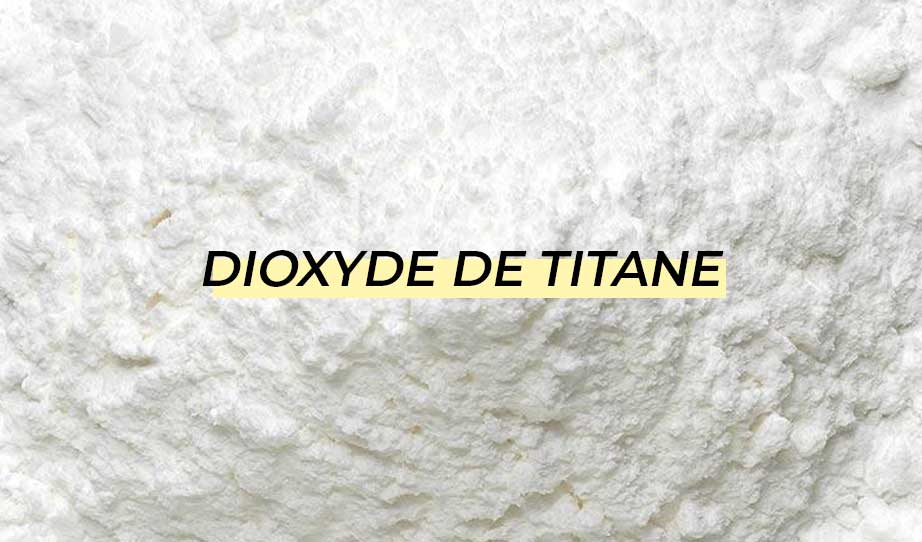
Titanium is naturally present on Earth. It's even the 4th most abundant metal. It is mainly found in ores. Once purified, it is found in the form of a white powder, titanium dioxide, which is then used in various applications.
To give you an idea, Pomponnette: about 5 million tons of titanium dioxide are used worldwide every year.
And for the record, it was discovered in Russia at the end of the 18th century, then began to be used as a whitening agent from the 20th century.
What are the functions of titanium dioxide? Why is it used?
Titanium dioxide is found in a large number of products: cosmetics, medicines and food supplements, clothes, pastries, sweets, toothpaste, rackets… In fact, more than a thousand consumer products contain it.
In cosmetics, it can be used for these two purposes:
- Opacifying/coloring agent: it is the only white colorant available on the cosmetic market. It will therefore allow formulas to be whitened.
- Mineral sunscreen filter: it is found in sunscreens, particularly natural and environmentally protective ones. This is also why some natural sunscreens can leave a white appearance.
For lipsticks, for example, it can be used in light shades, such as pale pink, where it is then mixed with a red pigment.
We better understand why its integration into consumer products is interesting: the introduction of titanium dioxide into a formula allows for new properties and the development of innovative, more natural materials.
Moreover, the notion of the size of titanium dioxide particles is very important. Have you ever heard of "nanoparticles"?
Titanium dioxide exists in two forms: nanoparticulate (particles with a size smaller than 100 nm, 1 nanometer = 10-9 meters) and non-nanoparticulate (i.e., larger than 1 nanometer, no need for advanced math to understand that 😉)
In the field of cosmetics, the use of titanium dioxide in its "nano" form, as it is called, poses some problems...
What are the dangers of titanium dioxide?
Titanium dioxide is classified as a possible human carcinogen by inhalation by the International Agency for Research on Cancer (IARC). It is therefore prohibited in nanoparticulate form in aerosols.
Although it is not prohibited in other categories, the nanoparticulate form raises questions. Indeed, the particles are so small that there are fears they could pass through the skin barrier.
In any case, Pomponnette, as soon as titanium dioxide is used in its nano form, the mention [nano] is obligatory in the INCI list.
As a precaution, we therefore recommend avoiding products with nanoparticles.
To date, non-nanoparticulate titanium dioxide is not questioned.
Where is titanium dioxide found in its nanoparticulate form?
In its nano form, the particles are finer and cover the skin surface better. For example, in the context of sun protection, they protect the skin better from UV rays and penetrate better. This is what helps avoid the "white skin" syndrome when applying some natural sunscreens.
When it is used for its opacifying property, as for lipsticks, there is no point in adding nanoparticles. So you can easily choose a lipstick without titanium dioxide in nanoparticulate form, or a lipstick without titanium dioxide at all ;)
Titanium dioxide and Pomponne natural lipstick, THE alternative
At Pomponne, transparency regarding titanium dioxide is paramount. You will only find it in its non-nano form in the natural lipstick shades where a white colorant was needed, such as for nude beige, pale pink, or raspberry, in order to soften the red pigment. This form is risk-free for your health.
And good news, there are six lipsticks without titanium dioxide at Pomponne:
- Natural lipstick Orange Sixties
- Natural lipstick Poppy Red
- Natural lipstick Garnet
- Natural lipstick Plum
- Natural lipstick Couture Red
- Natural lipstick Cherry Red
When choosing a lipstick, several questions arise. Especially if you are committed to clean beauty and natural makeup is important to you. The first thing to do is to check the lipstick's composition, both for the well-being of your lips and for the planet!
For example, you can ask yourself this question: if the lipstick contains titanium dioxide, is it present in its non-nano form? If the answer is yes, then you can go for it!
We invite you to use applications such as Yuka. A simple scan of the barcode is enough to give you a precise analysis (otherwise, to help you decipher an INCI list, there's this blog article).
In this regard, Pomponne is a good student: all shades of our natural lipsticks are rated "excellent" on Yuka! You can consult our "never list" of ingredients for the formulation of our natural makeup right here.
At Pomponne, the ingredients of each natural lipstick are clearly listed. No surprises about titanium dioxide. You can see the INCI lists for each shade of our natural lipstick here in the "ingredients" section.
To learn more about Pomponne natural & hydrating care lipstick, click here!
A smile does good,
let's spread the Smile Power!
Agathe & Charline
2 comments
Ce commentaire est très intéressant je suis entièrement d accord.
Le problème du dioxyde de titane dans le rouge à lèvres est qu’on l’ingère dès que l’on mange ou qu’on s’humidifie les lèvres. Qu’il soit nano ou non ne change alors rien à sa toxicité.
Merci d’avoir 3 rouges à lèvres sans dioxyde de titane. Si vous pouviez vous pencher sur un baume à lèvres légèrement teinté dans dioxyde ou une forme qui permette d’avoir une couleur légèrement teintée sur les lèvres ce serait formidable !