



Because we wanted a great article about vegan makeup, we called on Isabelle Derson's writing skills to explain why you should choose vegan lipstick. We're now handing over the floor, or rather the pen, to our Pomponnette Isabelle!
We all want to lead a healthier life, reduce our environmental impact, limit our waste... but let's face it, it's often complicated with our busy lives. Reducing our consumption of animal products is an accessible way for everyone to take concrete action. This initiative concerns both our plates and the products we apply to our skin. It's part of a holistic approach to self-respect, respect for the environment, and respect for animals. Choosing a vegan and cruelty-free lipstick is a way to treat yourself and take care of yourself, while working towards a better world. It's through everyone's small actions that we can make the planet smile.
Why choose veganism?
For the environment
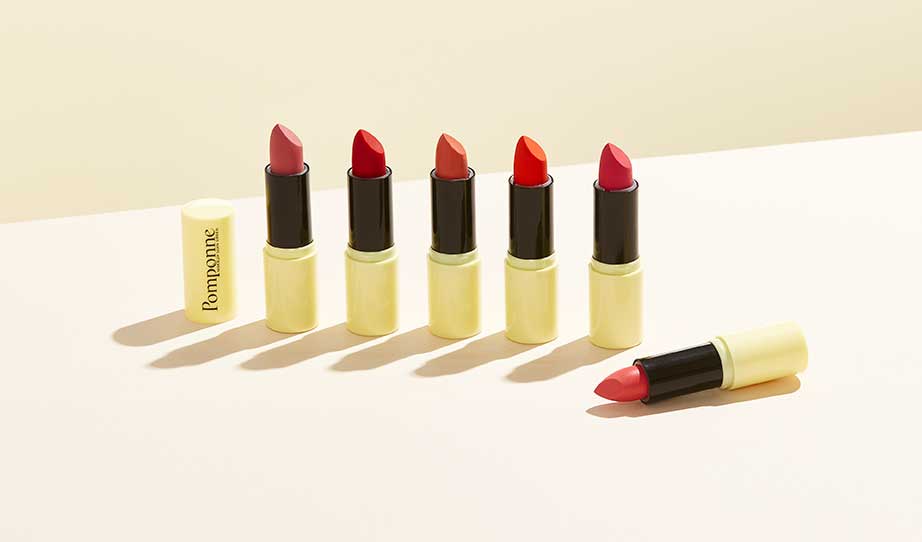
Animal farming has an undeniable environmental impact: massive water consumption, greenhouse gas production, deforestation, soil pollution, biodiversity loss, etc. This concerns both direct animal farming and all the food production for these animals. Even if every product has an environmental footprint, that of animal products is particularly significant, whether for our food or for cosmetic products. Make no mistake: the ingredients used for cosmetics are not necessarily by-products of farming. Some animals are raised and killed specifically for cosmetics. This is notably the case for carmine, a natural red pigment obtained by grinding cochineal, female insects (it takes about 140,000 insects to obtain 1 kg of pigment). This pigment is often used in natural products to achieve a vibrant red. At Pomponne, poppy red lipstick does not contain it, which is why its percentage of ingredients of natural origin is 95% and not 100%, as it is a "SAINthétique" red pigment so that cochineal can be free to smile :)For health
According to WHO recommendations, an optimal diet aims to limit the consumption of animal products and favor fruits, vegetables, grains, legumes, etc. Animal products are at the origin of the explosion of cardiovascular diseases and are believed to promote many cancers. Furthermore, animal products often contain high levels of hormones and antibiotics. Whether in food or cosmetics, limiting products of animal origin and ensuring their source and quality becomes necessary. It's better to consume less but better ;)
For animal protection
Of course, most people are primarily concerned about how animals are treated. The terrible images from slaughterhouses regularly remind us how cruel intensive farming is to them. The pursuit of profit makes us forget all concern for the welfare of animals. As Paul McCartney points out: “If slaughterhouses had glass walls, everyone would be vegetarian.”
Even dairy farms that do not directly kill cows subject them to very difficult living conditions. Cows are artificially inseminated every year to maximize milk production. Farmers remove their calves directly (which causes physical and emotional stress). Dairy cows live only 5-6 years due to disease and exhaustion, compared to 20 years normally. Even if regulations are increasingly being put in place to address this issue, we can all act at our level by limiting our consumption as much as possible, opting for plant-based alternatives, and choosing local butchers or cooperatives rather than buying supermarket brands that come from intensive and unreasonable farming.
What animal-derived products can makeup include?
Two types of animal-derived products are used in many cosmetics: those produced by animals (like milk, honey, etc.) and those extracted directly from the animal (like keratin, fat, etc.). In both cases, it is legitimate to question how these substances are obtained. These products can also be transformed to create other ingredients. Therefore, it's not easy to figure out. It's always best to rely on vegan and/or cruelty-free labels (for cosmetic brands outside the EU, since regulations prohibit animal testing in the EU).
Here is a non-exhaustive list of animal-derived ingredients found in many cosmetic products, knowing that they may have other names to mislead:
- Pork and beef fats, especially tallow and oleic acid, which are derivatives (the use of whale fat is now prohibited)
- all milk derivatives
- bee products like honey, royal jelly, or beeswax
- the red pigment carmine is obtained by grinding insects (cochineal)
- glycerin often comes from animal fats, recovered from carcasses
- collagen and elastin, gelatin derivatives, are proteins extracted from animal carcasses (often pigs) or, more rarely, fish skins
- chitosan is extracted from crustacean shells
- guanine comes from fish or snake scales or even bird droppings
- lanolin comes from sheep's wool
- lecithin and albumin are obtained from eggs
- allantoin is an extract of snail slime
- squalane or squalene comes from the hydrogenation of shark liver oil
- glycosaminoglycans come from mammalian or mollusk organs and tissues
- keratin often comes from poultry feathers or sheep's wool
- musk is secreted by certain animals (deer, civets, muskrats)
- lactic acid most often comes from animal milks
- silk protein comes from silkworms
- fish oils are used as a source of unsaturated fatty acids.
It is possible to find variants (vegetable or synthetic) for most of these substances. However, cosmetic regulations do not require mentioning the origin of ingredients. Glycerin will be listed as "Glycerin" whether it is vegetable or animal. To check, simply look at the percentage of ingredients of natural origin: if it exceeds 95%, there is a good chance that the product is natural.
Therefore, prioritize products that mention the absence of animal-derived products or carry a vegan and cruelty-free/not tested on animals label (such as the leaping bunny). Finally, note that "castor oil" has nothing to do with the animal... it is simply castor oil (we explain how to decipher an INCI list here). The term, however, refers to castoreum, secreted by the beaver, but which is no longer used today.
Composition of Pomponne vegan lipstick
A unique formula, guaranteeing comfort and effectiveness, to pamper your lips like never before:- St-Malo seaweed: for optimal hydration, a flawless lip contour and more volume;
- Super shea butter: 3 times more concentrated in moisturizing unsaponifiables. It helps reduce inflammation and the volume of chapped lips;
- Wild mango butter: hydrates, protects and repairs lips to restore their softness and suppleness;
- Aloe vera: the ultimate moisturizer.
It is therefore a true moisturizing treatment, clinically tested and prioritizing ingredients of natural origin (from a minimum of 95% to 100%). Only pigments can be 'sain'thetic in the formulas. In addition, it is made in France. In addition to being vegan, it is clean: so no parabens, phenoxyethanol and other endocrine disruptors, mineral oils and synthetic hydrocarbons, silicones, essential oils, soy, gluten... (Pomponne's Never List formulation is available right here). The whole is presented in an eco-responsible 100% recyclable package for an environmentally friendly approach.
Other tips for a vegan makeup bag
In addition to vegan lipstick and other makeup products, also consider accessories and skincare. 100% plant-based products are now available and affordable. First, the bag itself: no leather, of course! Also think about vegetable oils for makeup removal. You can also find natural sponges and synthetic fiber brushes: hypoallergenic, durable, just as effective, and much more ethical. Furthermore, all sorts of vegan and cruelty-free skincare products are now easily accessible.
While makeup products without animal products were rare or perhaps of lesser quality a few years ago, the situation is completely different today. There are plant-based options for products used in traditional makeup. The Pomponne vegan and clean lipstick is proof of this. It is the result of numerous trials to offer you an ideal, high-quality formula. Don't hesitate any longer and treat yourself while helping to protect animals and the environment. Every gesture counts.
Isabelle Derson